
Fields in the Dane County Owner Record
AccessDane's parcel card lists the published Owner separately from the situs and the billing address. Those fields answer different questions. A legal description and deed reference confirm the record belongs to the land in question. The assessment summary belongs to the tax roll instead.
| Owner | Published owner-of-record name; online display can be opted out |
|---|---|
| Billing address | Tax-mail destination, which may differ from the parcel |
| Situs address | Physical address attached to the property |
| Parcel number | County key for matching tax, GIS, and deed records |
| Legal description | Land description to compare with the recorded deed |
| Last sale / deed | Record link or reference where available |
The owner of record is the party named in the county's property system. It is not an occupancy list. A trust or LLC may appear instead. A recent conveyance may lag behind the roll. The sample AccessDane parcel record shows the county's owner, address, assessment, and map fields together in one view. Note the assessment year too. AccessDane places tax history, land description, and a map reference near the published owner. Those are still separate data points. A current mailing address routes the tax bill, and it does not prove the owner lives at the situs. The Dane County sample parcel card illustrates how owner, billing, situs, assessment, and map fields sit side by side.
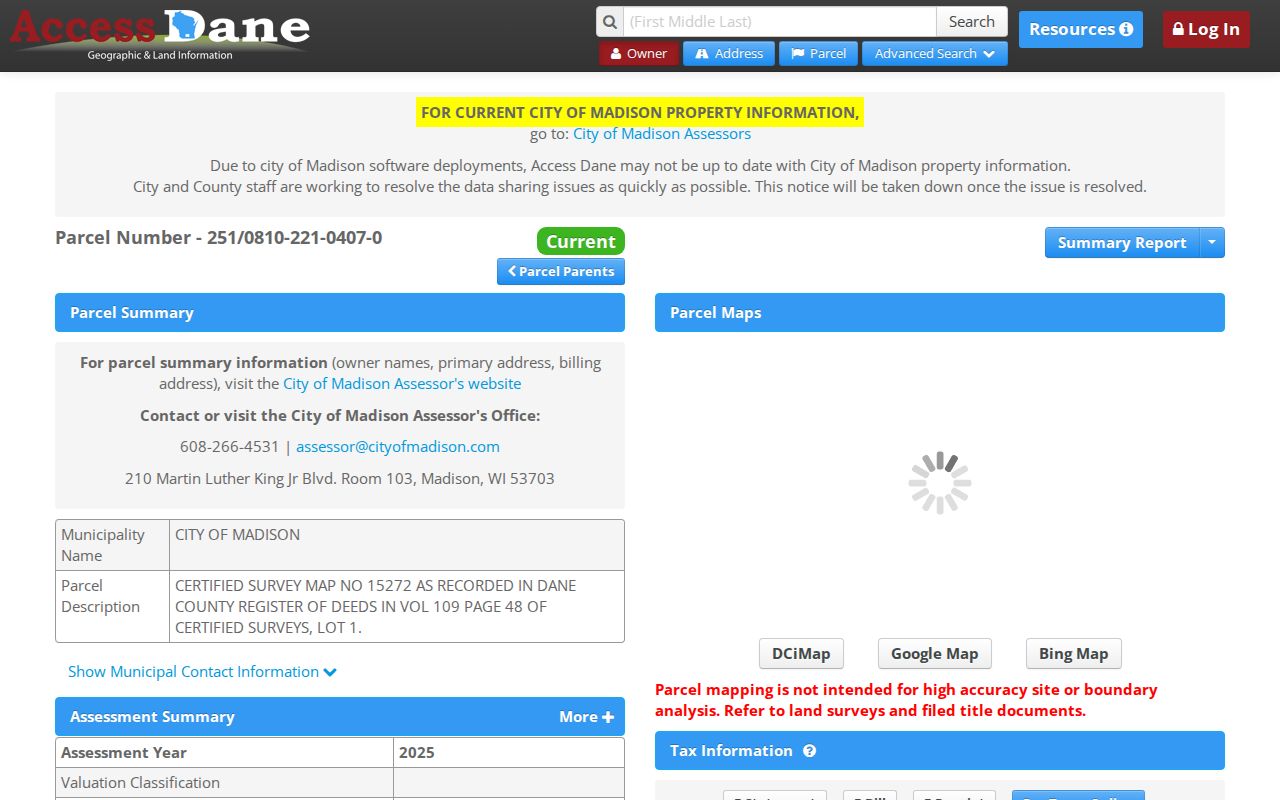
The parcel number and legal description keep the owner field tied to a single tract of land.
Separate Situs from the Tax Address
Situs is simply where the parcel sits. The billing or mailing address is where the tax notice goes. An absentee owner, a trust, a company, or a billing agent changes things. The two addresses can sit far apart. Keep both in your notes. That habit stops a tax-mail destination from being mistaken for the property location. The Treasurer FAQ explains the tax-history fields and how to correct a mailing address. A deed may list a grantee's notice address. The tax record can carry a different current destination. Use each source for its own purpose. A tax notice may come back. A billing address may also change after a sale. Follow the Treasurer's instructions for that account. Never edit a public name or infer a new owner from mail forwarding. The situs, the billing address, and the deed's named recipient can all differ. All can point to one parcel.
How Current Is the Dane County Roll?
Dane County's official pages promise no fixed delay between closing, recording, and the owner field. Timing is variable. The Treasurer notes that normal documents submitted to the Register of Deeds should update billing information automatically. An AccessDane sample warns that Madison data may be stale during a software deployment. So no number of days is safe to quote. When the most recent deed is dated later than the assessment display, let the deed confirm the present grantee. The roll still matters. It carries the parcel and tax context that a deed alone lacks. Note the record date and the deed's recording date. Those dates tell you which source is fresher. Never call an update immediate. A specific day count would be invented rather than sourced.
Dane County Owner Privacy and Opt-Outs
AccessDane's Internet owner display is opt-out. The county reports that roughly 97 percent of owner information is published. An owner can still request removal. A hidden web name does not erase the land record, since municipal and county counters may retain access for public duties. Safe at Home participants use a substitute address. That Wisconsin program exists to shield a protected residence. Public records should never be used to expose one. The public display is not the only official source anyway. Use the county's current privacy process for an opt-out or a record question. Treat a suppressed field as a privacy choice. It is not an invitation to hunt through unrelated databases for a home address. Check the counter before assuming a record is missing.
Read Entity Vesting in Dane Deeds
The owner of record is not always a person. A trust, LLC, or estate can hold title. The Dane County parcel record may then list only the entity name. The deed names the grantee and states how the conveyance was made, which is the vesting language that controls. Wisconsin DFI supplies entity status and registered-agent details, while a probate summary can explain an estate transfer.
One caution deserves emphasis. A registered agent is a contact point, not the person who owns or controls the parcel. Keep the inquiry on the instrument, the legal description, and the current parcel. A business filing alone proves no parcel relationship. You need a deed to make that link. Estate transfers add another layer. Probate may involve a personal representative deed, a transfer-on-death affidavit, or a court-authorized transfer, and the case file shows who may act for the estate. When the grantee is an entity, compare the exact vesting language instead of substituting a manager, beneficiary, or registered agent for the named owner.
Confirm the Current Dane County Owner
Confirming a Dane County owner takes two records. The property roll names the public owner, while the latest deed conveys the same land, so a later recording date on the deed deserves the first look. Check the grantee and legal description first. The online land index begins in January 1975, so rely on the office for older documents or an incomplete chain of title.
- Copy the AccessDane parcel number and legal description.
- Search the Register of Deeds index for the latest conveyance.
- Compare grantee, recording date, and land description.
- Check entity or probate records only when the deed names one.
- Owner of record
- The party named in the assessment property record.
- Vesting
- The way an instrument states ownership, including an entity or trust.
- Situs
- The physical property location.
- Billing address
- The tax-mail address, which can differ from situs.
- Recording lag
- The unquantified time between recording and a later roll display.
Use both sources. A current-owner check works best when the public owner field and the latest deed agree. Do not rely on whichever screen was refreshed most recently. The parcel number ties them together. The recording date shows when the deed entered the index. If the legal description covers only a unit, fraction, or portion of a larger parcel, keep that qualification attached to the owner result. That keeps the owner result accurate.
Madison Owner Data Can Follow a Different Schedule
Madison parcels run on their own clock inside AccessDane. The county portal carries a notice that Madison parcel information may follow a different deployment schedule than other Dane County municipalities. An owner name, assessment, or situs detail for a Madison parcel can look stale as a result, even when the countywide display seems current. Compare the city's current source against the recorded deed. Keep the parcel number and date from each result. That makes any disagreement easy to sort out.
A parcel card in AccessDane pulls owner, tax, assessment, legal-description, map, and related land-record details into one view. The owner field is a strong lead. It cannot prove that a recent transfer has propagated through every screen. The Dane County sample parcel record carries the Madison deployment notice and shows the linked record fields.
Madison is the exception to Dane County's usual countywide Property Listing arrangement. The county states that Madison ownership is maintained through a city assessor integration. Lag is the known side effect. Use the AccessDane card to identify the parcel. Then verify a recent transfer in the deed index. When the county and city displays disagree, keep the parcel key, review the city's current assessor source, and confirm the transfer in the recorded deed instead of averaging the two.
Use Dane County Owner Details Lawfully
Every public record has limits. The billing address on a Dane County owner record exists to route tax bills. It can serve a legitimate property matter, but it is not an invitation to contact someone at the parcel. Boundaries are built in. The county owner display, the opt-out process, and the Safe at Home program all shape what appears online. Reach out only for a lawful property purpose. Respect a request not to be contacted.
Names on the record can mislead too. A registered agent, personal representative, or trustee appears in a record because that person is authorized to act for an entity or estate, not because they personally own or live at the parcel. Describe the record as filed, and get legal help when vesting language or a shared interest must be interpreted for a transaction.
Lawful use. Use public ownership data for property research and due diligence. Do not use an owner's name or address to stalk, threaten, or harass anyone.