
Three Dane County Property Value Measures
Value means different things depending on the record. It can be an assessment, a statewide comparison figure, or a completed sale price. AccessDane parcel records carry assessment detail where available. A recorded deed or transfer trail supplies the sale reference, so note which measure a number came from and the date attached to it.
| Value | What It Is | Where |
|---|---|---|
| Assessed value | Value entered on the local assessment roll | Municipal assessor / AccessDane |
| Market-level estimate | Estimate tied to the valuation date and local method | Assessor notice and roll |
| Equalized value | Municipal comparison measure used by Wisconsin DOR | DOR reports by year and municipality |
| Recorded sale price | Consideration reported with a completed transfer | Deed / transfer record |
Label every value with its type and date. Assessed value sits on a local roll. Equalized value compares municipalities. A recorded transfer documents a past transaction, and mixing these figures can make a parcel look like it changed value when the sources simply answer different questions. Wisconsin DOR explains assessment ratios and publishes municipal aggregate ratios and equalized values. Those numbers compare communities and tax burdens. They do not appraise one parcel. A recent sale can also differ from a roll value because the sale date and the assessment date rarely line up.
Read the Dane County Assessment Fields
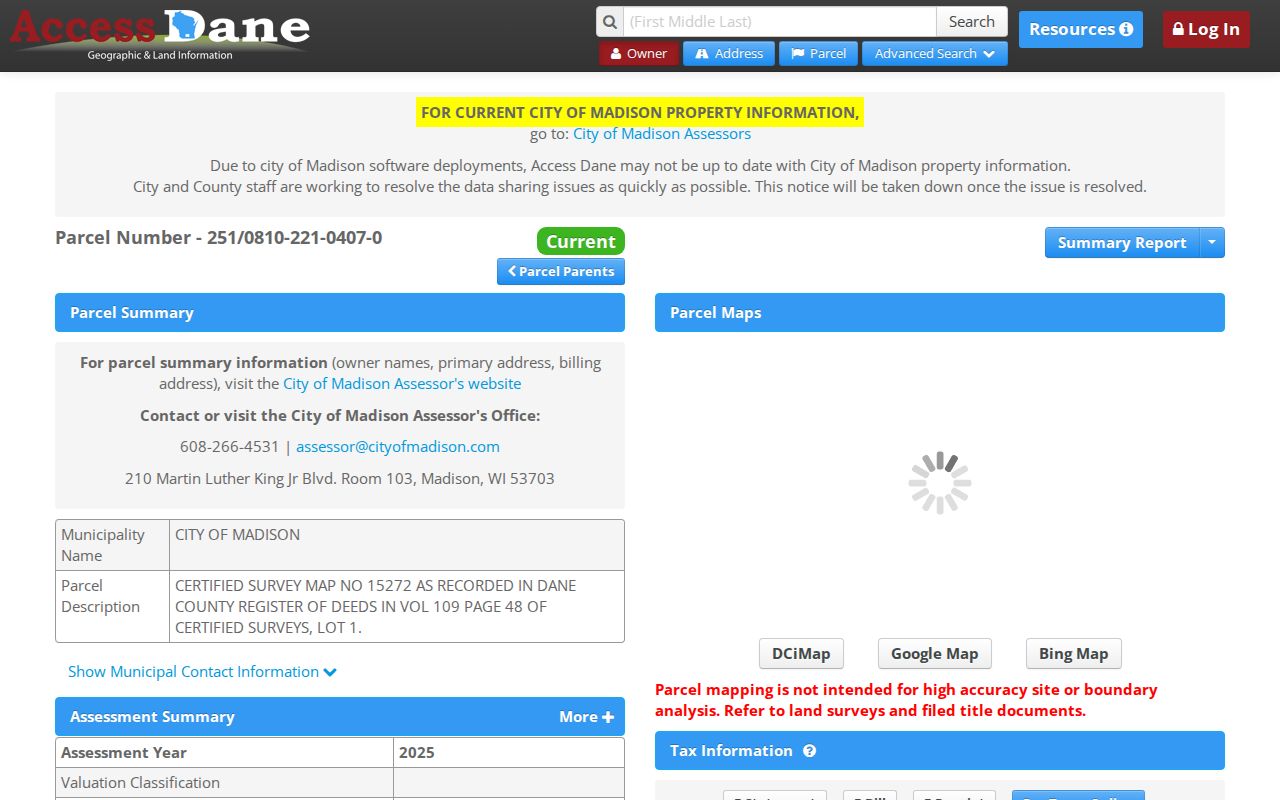
AccessDane can display land, improvement, and total assessment as separate parts of a parcel card. Land covers the site itself. Improvement covers the building or other assessed work. Total adds the listed pieces together. The sample card links to tax information and legal-description detail, though not every view exposes the same history. The assessment year matters most. A value from one roll should never be compared with a sale from another year as though both were current market quotes. Keep parcel number, roll year, and source together. The sample AccessDane parcel result shows how value and tax fields sit beside parcel details.
Trust the parcel's own record instead of applying a county average to one lot.
Dane County Ratios Are Not Appraisals
Wisconsin's assessment ratio compares assessed property values with estimated market value across a municipality. DOR reports aggregate ratios and equalized values for tax allocation. Those are comparison tools. A municipal ratio says nothing about one home. Match the report year and municipality. A parcel in Madison, Fitchburg, or Sun Prairie can face different local assessment context than a town parcel. Return to the assessor's notice for the parcel's own description. See Wisconsin DOR's assessment reports for municipal ratios and equalized value. The annual reports show how a municipality's assessments compare with estimated market value in a stated year. The ratio offers context, aggregated across many properties. It is not a multiplier. It will not turn one parcel into a current asking price. Check the report year and municipality before any comparison.
Dane County Sale Price Lives in the Transfer
A sale price proves a transaction, not what the property would fetch today. The deed ties the conveyance to a date. The transfer record adds the legal description. A parcel card may carry a related land-record link, while the Register of Deeds index retrieves the instrument by its document number. Compare the transfer against the right parcel. Account for any split, condominium unit, or legal-description change. The current assessment can carry a valuation date different from the recorded sale. Deeds describe consideration, parties, exemptions, and the share transferred. Those details shape interpretation. A family transfer, estate conveyance, or partial interest is not comparable to an open-market sale. Match the instrument's full land description to the current parcel. Use the recorded date, not a later website update, as the transfer marker.
Look Up a Dane County Value
Start with the parcel record. Confirm the assessment year. Reach for the deed or transfer reference only when the question concerns a sale, and keep the recorded date beside the price.
- Search AccessDane by address or parcel and open the parcel card.
- Read the assessment year and land, improvement, and total figures.
- Use the related deed record to confirm a sale and its date.
- Check the municipality's assessment notice for its review process.
- Assessed value
- The local roll figure used in property-tax calculations.
- Market value
- An estimate of likely exchange value at a stated date.
- Assessment ratio
- A municipal comparison of assessed and estimated market value.
- Equalized value
- A state-adjusted municipal measure for tax distribution.
- Sale price
- Consideration recorded for a completed transfer.
Note the jurisdiction and roll year. Record the assessment components too. A condominium building result can differ from the assessed unit, and a split lot may carry a new parcel number. Municipal boundaries decide which assessor supplied the value. Use the notice to find the review route if a description or figure looks wrong.
Sun Prairie's 2026 Value Shift
Sun Prairie announced a citywide revaluation for 2026, with assessments intended to reflect market value as of January 1 and values anticipated in late July. The city cautions that an increased assessment does not mean every owner's taxes will rise. The assessment measure and the final bill are related but not identical.
The city links residential sales spreadsheets for 2024 through 2026, historical AccessDane information, neighborhood mapping, and state assessment guidance. Treat this as Sun Prairie-specific context, not a countywide value change. A parcel-level result still needs its own roll year and legal description.
The Sun Prairie Assessing page posts the revaluation notice.
The 2024-2026 Sun Prairie residential sales spreadsheets can help show the city's transaction context across recent years. Compare a candidate sale's date, parcel description, and transfer terms before treating it as a comparable value; a spreadsheet does not account for partial interests, family transfers, or improvements made after a transaction.
Exemptions Change Taxable Value
An exemption changes the taxable amount without touching the assessed value. That distinction trips up a lot of owners. Assessment, exemption, and bill are three separate fields, and mixing them leads to wrong conclusions. The assessor's records and the Treasurer's records answer different parts of the question. Check each one for what it actually covers.
Need exemption rules, payment status, or an appeal schedule? Turn to the Dane County property tax records information instead. Do not treat a value comparison as a tax calculation. The local notice and tax detail for the specific parcel carry the authoritative numbers. The assessed figure, any exemption, and the taxable amount stay distinct on the roll.
Remember what a bill depends on. Levies and local charges drive much of it. A higher assessment alone cannot tell a household what it will owe. Use the actual E-Bill and the notice for the year in question.
Wisconsin DOR's 2025 assessment and sales-ratio material offers a dated statewide comparison by municipality. It does not estimate a current sale price for one Dane County parcel. When you read any value trend, identify its source. Is it a local roll, a DOR ratio, or a recorded transaction? Keep the year beside the amount in every case.
Suppose a value looks inconsistent with the property's description. Start with the notice. Then confirm the local assessor's review calendar. Open Book and Board of Review dates vary by municipality. A taxable value question may also involve an exemption or a levy. Compare the assessment and the tax bill separately before concluding that one change caused the other.
What Dane County Property Value Cannot Promise
An assessor's figure serves tax purposes and can lag a shifting market. A statewide ratio compares municipalities. A recorded sale is a past transaction on its own terms. None of these numbers guarantees a future sale price. None replaces an appraisal prepared for a specific use.
Value versus price. A Dane County assessment is not what a property will sell for. Use a qualified appraiser when a parcel-specific market opinion is needed.